
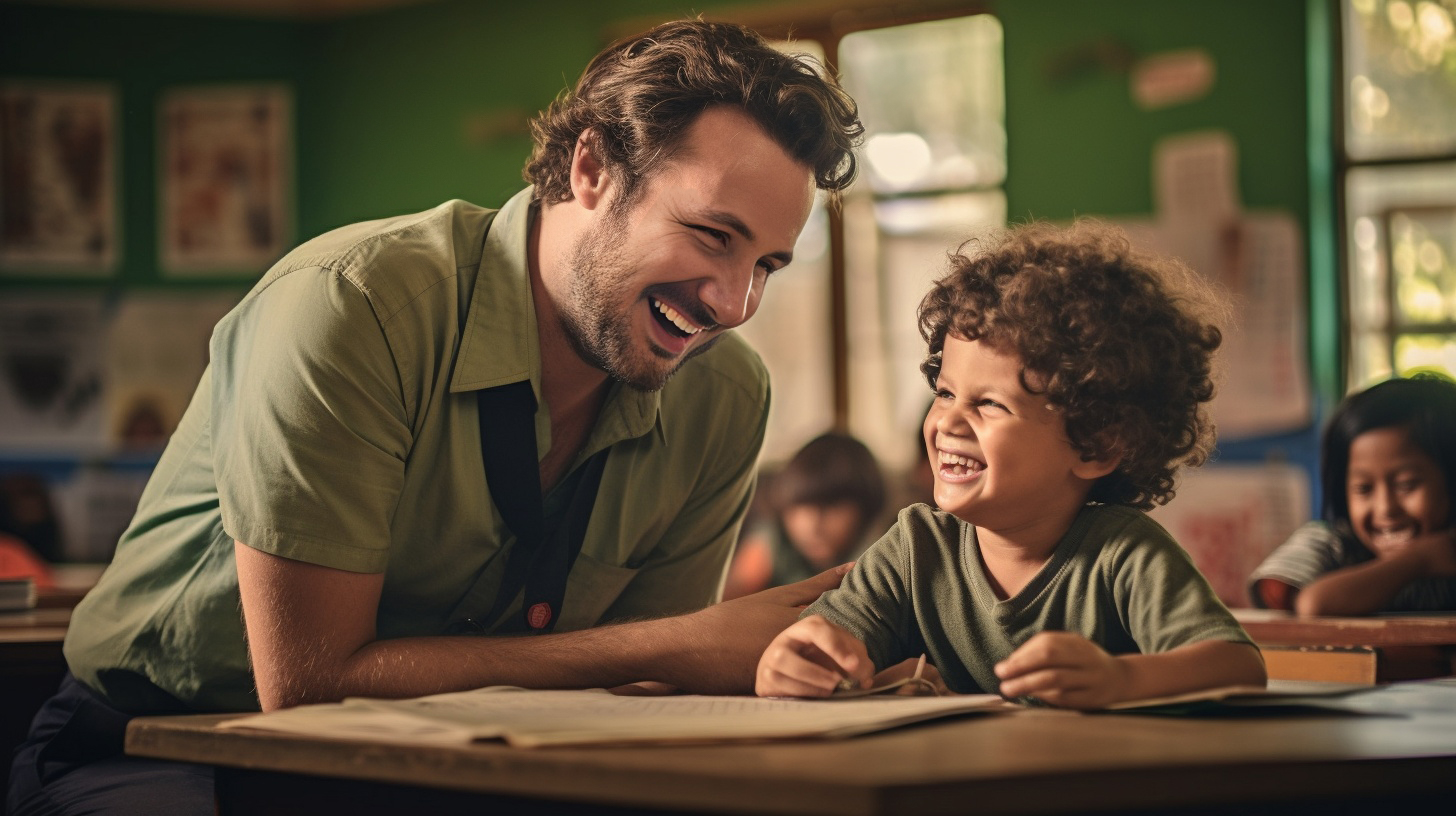
I don’t believe a teacher can be effective without building strong relationships with their students. Learning in primary schools is not the same as learning in secondary or university. Older children, or young adults, deliberately choose they want to learn for whatever reasons (e.g. personal interest, complete a degree, pursue a career…) However, young children are meant to play, like any other young mammals. That’s why building those relationships, and ensuring the learning environment feels like a safe, engaging, calm and funny place, is essential.
You would say, “It is just common sense”; and yet there are lots of professionals who don’t start with those relationships, or who just struggle building strong and healthy bounds with the children.
Consistency and fairness are two of the keys. I stick to my principles and “rules” and I apply them until the end. Once you know the individuals, you will know when to make exceptions, and what alternative strategies you could implement for those students.
Above those two factors I mentioned above, it is the sense of safety. Young children should feel (and be) safe in the learning environment you have planned and created. The most important rules need to be the ones pursuing that goal. Everyone’s safety is above everything else.
Going back to the relationships themselves, it is, again, about consistency, understanding, and psychology, particularly positive psychology. Teachers need to know the children’s interests and strengths—and then use that knowledge to manage the classroom efficiently. It is like sculpting the classroom dynamics in marble; you need to be patience, making sure you don’t take off too much.
Another key idea is that you are just a role model, and as a role model you should encounter the same issues your students would encounter themselves. You don’t have to pretend to know everything. Asking questions is an honest way to say, “Yes, I am a teacher, and yet you can teach me some things I don’t know.” Show genuine feelings when you speak to children; if you share a common hobby or interest, express it normally. Adults naturally smile and show excitement when meeting someone with shared interests, and teachers should do the same. Don’t overreact or act strangely—just be yourself. That includes using your regular voice. You are talking to young children, not babies. While high-pitched talk is beneficial for babies and young infants, as children grow and their language develop, we should switch to more natural adult speech to helpthem continue developing more advanced communication and social skills.
*This is a very common misconception. I’ve seen many teachers using high-pitched speech with not only Reception or Year 1 children, but even children in Year 6. Transitioning to a more natural voice would also help you build stronger relationships with the children are they would perceive you as someone who treats them like an equal.
It takes a few weeks or even months to get to know the majority of the children in your class. Eventually, you’ll find that children want to spend time with you. Use this time to teach character. What do I mean? Let me explain.
As you may or may not know, I am deeply interested in child psychology and have started applying positive technology in my classroom. Positive psychology focuses on people’s character strengths rather than weaknesses, emphasising positive reinforcement over a restorative or healing approach. I don’t think both sides of psychology are incompatible, so if what you’re doing works, keep doing it.
Dr. Martin Seligman defined positive psychology and the 24-character strengths as well as approached wellbeing in a very particular and innovative way (PERMA).
Anyways, I wanted to focus this blog post on classroom management and character by discussing micro-moments. What? You don’t know what micro-moments are?
In 2002, Daniel Kahneman won a Nobel Prize in Economic Sciences for his work in prospect theory, demonstrating that our memory of experiences is based on moments that only last seconds, categorised into good, bad, and neutral (which we don’t remember).
Ed Diener, known as Dr. Happiness, was a prominent figure in the field of subjective wellbeing. His research shows that subjective wellbeing (what we call happiness) increases creativity, good health, productivity, etc. This means that children need more positivity than negativity.

This is where I started thinking: If we remember the good and bad memories, and these are just moments that lasted a few seconds, how can we implement this in the classroom? If we could manage this, we would also increase children’s wellbeing, ultimately leading to more creativity, productivity, etc.
Then, when I came across Shelly Gable and her research about something called constructive responding. According to her research, any verbal interaction will be a combination of words, tone of voice, and your body language. This combination will create a response that will be categorised into one of the following types of responses: active constructive, passive constructive, active destructive, and passive destructive.
Let me give you an example of what those different responses would look like, and judge for yourself how the person being responded to might feel.
Imagine that a woman gets home and says this to her husband, “Oh my god! I’m so excited! The president of the company wants to meet me tomorrow to talk about the promotion I asked for!”
You see, objectively, this is a reasonably happy and important moment for that woman. Now let’s have a look at four possible responses. I won’t even comment on these myself. Judge for yourself.
- Active constructive: “That’s fantastic news! Congratulations on getting the opportunity to discuss the promotion with the president. I’m sure your hard work and dedication are being recognized. How can I support you in preparing for the meeting?”
- Passive constructive: “Oh, that’s interesting. I hope the meeting goes well for you.”
- Active destructive: “Really? I wouldn’t get too excited. These meetings are usually just a formality. They make you think you have a shot, but in reality, they already have someone in mind for the promotion. Don’t get your hopes up too high.”
- Passive destructive: “Meeting with the president, huh? Just keep in mind that these things don’t always turn out the way you expect.”
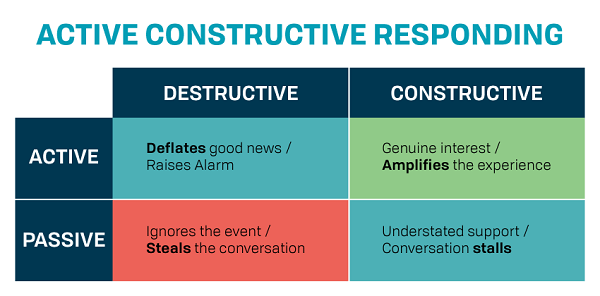
Now is where you can make a change in your classroom. Knowing about these different responses, you can begin using them in your interactions with children. Try and respond with active constructive responses as often as possible. In addition to this, use character behaviour in your responses, and you will be helping children internalise how hard they worked to feel that good, how gritty they have been to achieve that success, or how their social intelligence helped them work in their teams.
You are going to be surprised when, from now on, you pay attention to other adults interacting with other adults, you, or the children. You will see how often we relay passive constructive responses, even in destructive responses. This can help you manage your classroom, as well as improving children’s wellbeing, character strengths, and academics.
Being aware of this has had a positive impact on my practice, and I am now witnessing how the research of the aforementioned psychologists supports me in teaching children to lead a better and more successful school life.
 Mr Sanchez Tutoring