

Today, on October 17, 2023, we remember A.S. Neill, a special educator, as he would have turned 140. Let’s think about his life, his ideas, and how he changed education all over the world.
A.S. Neill: A Quick Story

A.S. Neil, or Alexander Sutherland Neill, was born on October 17, 1883, in Forfar, Scotland. He became a renowned educator and made history by founding the Summerhill School in 1921. This school was ground-breaking and reflected his innovative ideas in education.
Neill’s approach to education was different from the usual. His unique ideas challenged traditional ways, providing a fresh perspective that still inspires today’s educational discussions. Neill aimed to create a learning environment that celebrated individuality, autonomy, and the overall development of students, making him a visionary in education.
The Summerhill School, under Neill’s guidance, became a symbol of progressive education. It embodied his belief in giving students the freedom to explore, question, and learn at their own pace. This unconventional method, based on democratic principles, mirrored Neill’s educational philosophy.
Looking back at A.S. Neill’s legacy, his impact goes beyond his lifetime. His lasting influence shapes discussions about education, urging educators and learners to adopt innovative and student-focused approaches. A.S. Neill’s story isn’t just history; it’s an ongoing narrative that encourages us to imagine and work towards educational environments that empower individuals to reach their full potential.
The Summerhill School Idea

A.S. Neill’s education philosophy centred on the belief that children should have the freedom to shape their own learning journeys. He put this belief into action by creating the Summerhill School in Suffolk, England. This innovative school became a model for Neill’s visionary ideas.
Neill wanted to free students from traditional education constraints. His vision for Summerhill was a place where each child could express their unique selves. The school aimed to nurture creativity, critical thinking, and self-discovery, guided by the idea that education should be liberating, not restrictive.
Founded in 1921, Summerhill School reflected Neill’s commitment to democratic education. Students actively participated in decision-making, turning the idea of democracy into a real experience for everyone. Neill believed that learning should be a joyful and self-directed experience, challenging traditional ideas. Summerhill rejected rigid curricula, giving students the freedom to choose their courses based on interests. This not only empowered students but also recognised the diversity of talents within the student body.
Summerhill School became a symbol of educational innovation, reflecting Neill’s dream of a place where knowledge pursuit was intertwined with celebrating individuality. The impact of this experiment echoes through time, influencing modern discussions on student-centred learning, autonomy in education, and the vital role freedom plays in nurturing young minds. As we explore the Summerhill School idea, we uncover a transformative chapter in education history, where A.S. Neill’s vision took root and continues to influence education worldwide.
Freedom in Learning:
A.S. Neill championed the concept of freedom in learning, firmly believing that children should have the autonomy to choose the subjects and topics that resonate with their interests and passions.
In his view, this freedom was not just a pedagogical strategy; it was a fundamental catalyst for fostering a genuine love for learning.
According to Neill, the essence of true learning lay in the alignment of educational content with a child’s intrinsic interests. When children have the agency to decide what they want to learn, the process becomes inherently enjoyable and meaningful. Learning becomes an exploration driven by curiosity, where each lesson is not a mandate but a choice, making the entire educational experience more personalised and impactful.
Neill’s philosophy emphasised that when children are actively involved in the selection of their learning paths, they develop a profound connection with knowledge. This connection transforms learning from a chore into a gratifying pursuit, instilling in children a lifelong love for acquiring new insights and skills.
In essence, Neill’s advocacy for freedom in learning was rooted in the idea that education should be a liberating force, empowering children to discover the joy of learning on their own terms. This philosophy continues to inspire contemporary discussions on student-centred education, recognising the immense potential that lies in aligning education with the natural inclinations and curiosities of each learner.
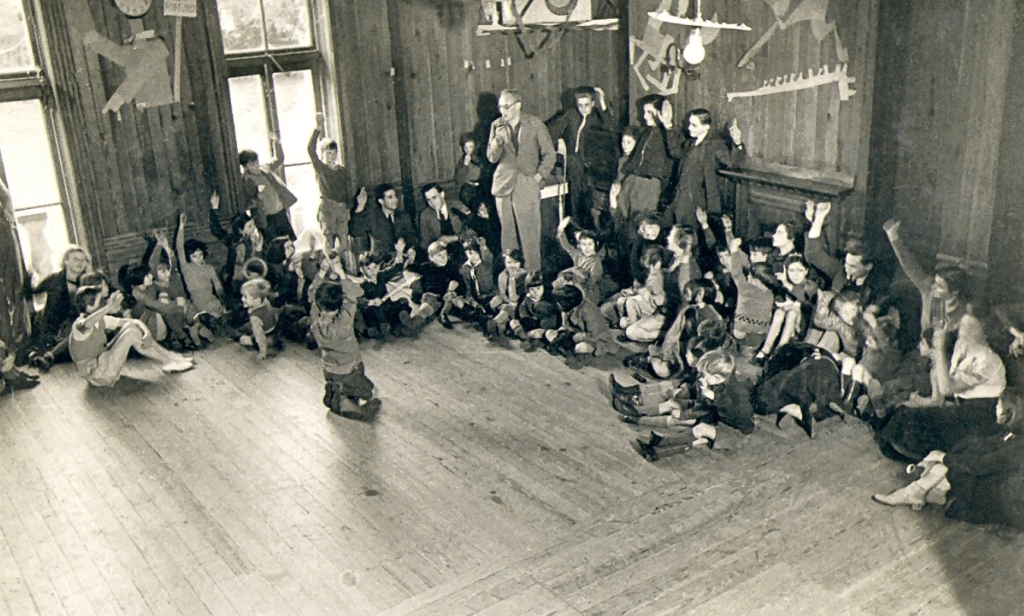
Everyone Decides Together:
At Summerhill School, the essence of democratic education came to life as the entire school community, comprising both students and teachers, actively participated in the decision-making process.
A.S. Neill envisioned a learning environment where everyone, regardless of age or role, had an equal voice in shaping the rules, policies, and daily operations of the school. This unique approach not only challenged traditional power dynamics but also served as a powerful lesson in fairness for the students. Unlike conventional educational settings where authority is often concentrated in the hands of teachers and administrators, Summerhill embraced a collaborative model. Students and teachers collaborated as equals, creating an atmosphere where diverse perspectives were valued and respected. This collaborative governance structure became a practical expression of democratic principles, providing students with first-hand experience in democratic decision-making.
This distinctive feature of Summerhill School went beyond theoretical notions of democracy. It translated the abstract concept into a tangible and lived experience for every member of the school community.
The equal participation of students and teachers in running the school not only contributed to a more inclusive and democratic educational environment but also served as a powerful educational tool. Through this collaborative governance, children learned about the importance of fairness, cooperation, and the shared responsibility of creating a thriving community.
Summerhill School’s commitment to shared governance was a testament to Neill’s belief in the educational value of democratic principles. This innovative approach left a lasting impact on the students, imparting lessons in equity, active citizenship, and the democratic values that extend far beyond the classroom.
No Forced Classes:
Summerhill School distinguished itself from conventional educational institutions by breaking away from the practice of mandatory classes. In contrast to traditional schools where students are compelled to attend every class in a predetermined schedule, Summerhill introduced a revolutionary approach—freedom of choice in learning.
At Summerhill, students were empowered to make decisions about their education. They were not obligated to attend every class; instead, they had the autonomy to choose the classes that resonated with their interests and passions. This shift away from strict rules about mandatory attendance was a big break from the usual and a crucial part of A.S. Neill’s vision to free students from traditional education constraints.

The absence of forced classes at Summerhill reflected Neill’s profound belief in the importance of intrinsic motivation in learning. The school aimed to cultivate a love for learning that emanated from personal engagement and choice by allowing students to select classes based on their genuine interests and curiosities. This approach recognised the diverse learning styles and preferences among students, acknowledging that a one-size-fits-all model does not cater to the individual needs and aspirations of each learner.
The freedom to opt out of certain classes was not merely a logistical adjustment; it was a fundamental shift in the philosophy of education. It communicated a message that learning should be a joyful and self-directed pursuit, rather than a forced obligation. Summerhill’s commitment to giving students agency over their learning experiences became a cornerstone of the school’s identity, emphasising the transformative power of choice in education.
How A.S. Neil Changed Education
A.S. Neill’s ideas were innovative in his time and still matter today. He showed us a different way of doing school that focuses on what each student needs and cares about. Neill’s legacy is about emphasising a personalised and student-centred approach to education, going beyond traditional methods. His ideas challenge the usual norms of education and continue to influence modern discussions about effective and meaningful learning experiences by advocating for a system that recognises and values the unique qualities of each learner.
His Legacy
- Different Schools: Neil’s ideas made other schools change. Now, many schools try to be more like Summerhill School.
- Caring about Feelings: Neill helped us see that children’s feelings are important in school, too.
- Learning that Fits Everyone: Neil taught us to make school fit each student. This is a big deal in how we think about teaching now.
Some Challenges
A.S. Neill’s ideas on freedom in education had supporters, but they also faced criticism. Some argued that children need a more structured environment with clear rules to prepare them for future jobs.
Critics believed that the real world, especially the professional world, operates with rules and expectations. They thought an educational system reflecting these structures would better ready students for the workforce. The idea was that a more rule-bound education would teach discipline, respect for authority, and a sense of responsibility—qualities seen as crucial for success in many careers.
This criticism didn’t disregard the importance of creativity and individuality. It was more a worry that an overly permissive education might leave students unprepared for challenges in traditional workplaces. Critics suggested a balance, saying that while encouraging creativity is crucial, it should be paired with an understanding of and preparation for the structured nature of certain professions.
Examining these challenges shows that the debate about A.S. Neill’s ideas goes beyond education philosophy. It extends into broader conversations about the purpose of education and how it shapes individuals for future contributions to society. The balance between the need for structure and the desire for freedom in education continues to be an ongoing topic in educational theory and practice.
Remembering a Great Teacher
A.S. Neill changed how we think about school. On his 140th birthday, let’s keep learning from him. We can make schools that are not just about tests but about making each child the best they can be.
Thanks to A.S. Neill’s ideas and innovations, teachers, parents, and leaders can keep making schools that care about each child. Happy 140th birthday to a teacher who made a big difference!
 Mr Sanchez Tutoring
Very nice. Thank you for writing about my father… Zoë Neill Readhead.
LikeLiked by 1 person