

Ancient Greek education was really important in shaping Western civilization. It wasn’t just about studying; it was a complete way of helping people get ready for active roles in their communities. In this blog post, I discuss ancient Greek education—how they taught, explore significant figures from that era, and understand the enduring impact that we still observe in today’s schools. The way they taught back then is like an echo that we still hear in modern education. It shows how their system wasn’t just about sharing information; it focused on thinking critically, growing as a whole person, and being good at communication. Let’s explore these timeless ideas that are the foundation of education, connecting us to the past through centuries and across different parts of the world.
Pedagogical Philosophy: The Role of the Pedagogue
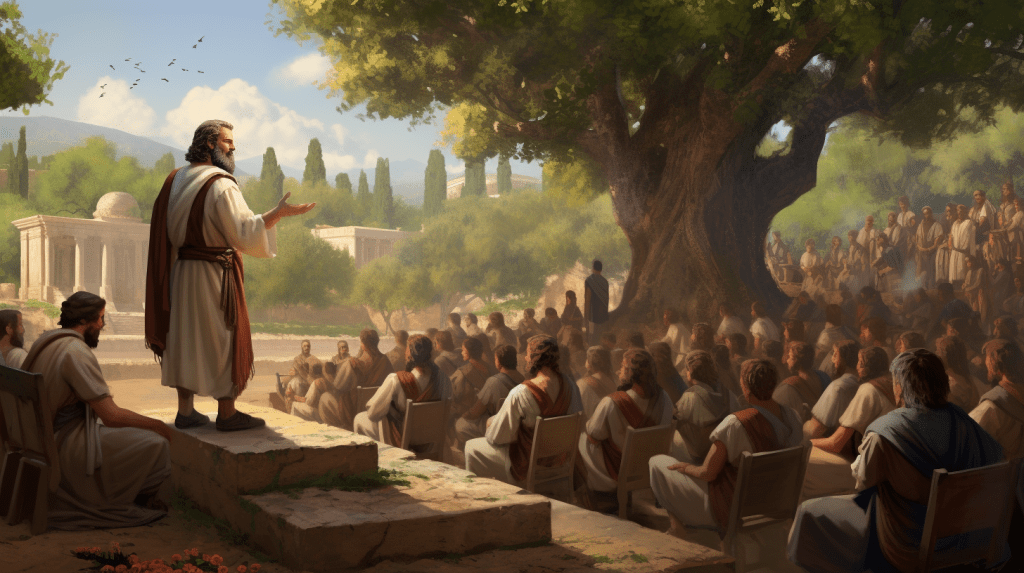
In ancient Greece, education was mainly for free-born males, and it was a significant part of their social status. This system was common from the 5th to the 4th centuries BCE and brought in the role of the pedagogue. This person, often a trusted servant, did more than just accompany children to school; they played a big part in their overall well-being and moral growth. The word “pedagogue” comes from the Greek “paidagōgos,” meaning “child-leading.” Famous philosophers like Socrates and Plato were involved in educational discussions, influencing the thoughts of the time. In the 1st century CE, Quintilian, a Roman educator, made important contributions, especially in rhetoric and oratory education. This era was a time when not everyone had access to education due to societal hierarchies. The pedagogue became a crucial mentor, guiding both academically and morally during the early years of ancient Greek civilization.
Pupils and Institutions: The Academy and the Gymnasium
Plato started the Academy in 387 BC, and it became an important place for advanced learning. They taught various subjects like philosophy, math, and astronomy. This centre of learning influenced many other places of education.
At the same time, the Gymnasium highlighted the Greeks’ focus on being well-rounded. It wasn’t only about being physically strong but also about growing intellectually and morally. This broad approach to education emphasised that being physically fit, smart, and having good morals are connected. Even today, the ideas from the Gymnasium still make an impact on different educational ideas.
Innovations in Teaching: The Socratic Method
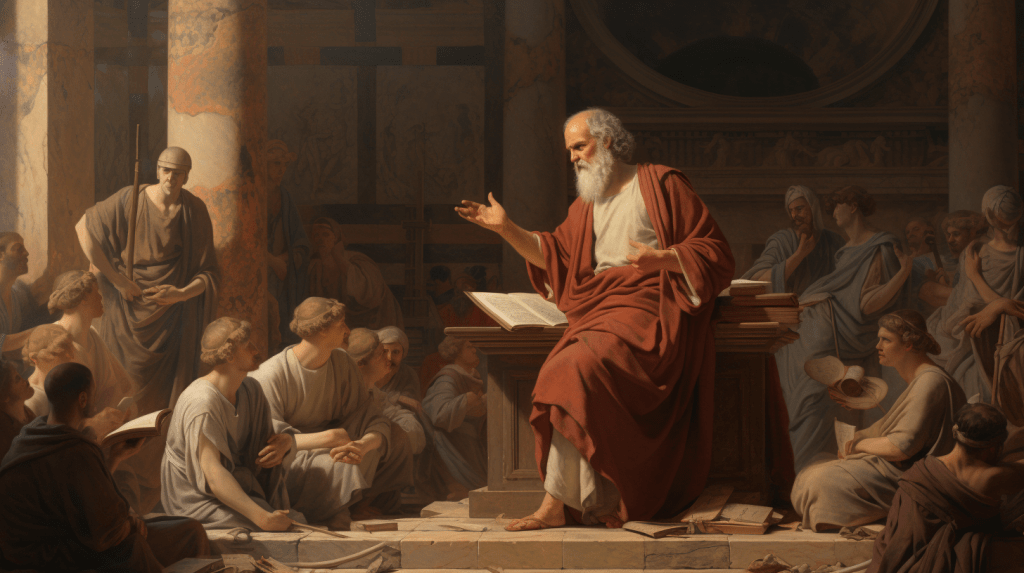
The Socratic Method, developed by the philosopher Socrates, changed how teaching happened. It started in ancient Greece and was a big shift from the usual way of just lecturing. Instead, it focused on lively and interactive learning. The instructor asked thought-provoking questions to encourage critical thinking and intellectual exploration. Students weren’t just listening; they were actively taking part in discussions, expressing and defending their ideas. This method wasn’t only about sharing information; it aimed to develop independent and logical thinking. Its impact has stayed strong over the years, shaping how education works around the world.
Style of Education: Rhetoric and Oratory Skills
In ancient Greece, especially in Athens, there was a strong emphasis on speaking well and using rhetoric. It wasn’t just about knowing the language; it was about being persuasive—a crucial skill for being active in public life and politics. Students didn’t just learn language details; they were trained in the art of communicating effectively and eloquently. Having good speaking skills was considered very important for those who wanted to be influential in civic affairs, where talking to the public and persuading them were crucial for success. This focus on rhetoric shows an understanding of how persuasive communication can strongly influence public opinions and contribute to a democratic way of thinking.
Literature and the Arts: The Trivium and Quadrivium
Ancient education had a specific structure based on the Trivium (grammar, logic, and rhetoric) and the Quadrivium (arithmetic, geometry, music, and astronomy). This well-rounded model aimed to develop individuals with a wide range of intellectual skills and a deep understanding of both the arts and sciences. Grammar focused on the details of language structure, logic on reasoning and critical thinking, and rhetoric on the art of persuasive expression. The Quadrivium combined arithmetic, geometry, music, and astronomy, offering a complete approach to mathematical and scientific studies. Together, these components formed a fundamental educational system that had a lasting influence on institutions for many centuries.
Notable Educators: Aristotle and the Lyceum
Aristotle established the Lyceum in 335 BC, and it became a noteworthy place for learning. Aristotle taught various subjects, ranging from ethics to biology, and his influence left a lasting impact on different academic areas. His work in ethics formed the basis for ethical theory, and his contributions to biology, particularly his groundbreaking classification work, played a crucial role in the development of scientific thought. Under Aristotle’s leadership, the Lyceum became a hub for intellectual exploration and discussions, making significant contributions to the progress of Western philosophy and science.

The Impact on Modern Education
The long-lasting influence of ancient Greek education still affects modern education globally. The stress on critical thinking, overall growth, and a wide-ranging curriculum is a key part of today’s education. This approach encourages students not only to learn but also to question, analyse, and think independently. As education ideas change over time, the timeless principles from ancient Greece persist. They are a vital part of the base of learning, helping to shape well-informed, involved, and intellectually agile individuals all around the world. Ancient Greek education is like a guide that continues to play a crucial role in developing the minds of learners today.
Bibliography
Jaeger, W. (1944). Paideia: The Ideals of Greek Culture.
Freeman, K. (2017). Schools of Hellas: An Essay on the Practice and Theory of Ancient Greek Education from 600 to 300 B.C.
 Mr Sanchez Tutoring
One thought on “What Was Education Like in Ancient Greece?”