

If you work in Education, you probably know how important it is to be adaptable to change. Our profession is always evolving, adapting to children’s unique needs, and also being aware to the world around us and its trends. All that became even more true during the 2020 COVID pandemic. I was still working at my former school, Foxborough Primary School, when we began a journey to support our pupils’ personal, social, and emotional development. This had always been a priority, at least on paper, but it became a big thing during lockdown times.
Our first move was to start using the Mood Meter and the RULER approach. These allowed us to support children in identifying and articulating their emotions. This step was essential in providing the necessary support for children to understand and manage their feelings. The Mood Meter became part of our daily routine; from EYFS, all the way up to Year 6. We even used it in our weekly teachers’ meetings!
However, back in 2022, a big change happened when we started using the Zones of Regulation. While this approach shares a common goal of emotional awareness with the RULER approach, it stands out for providing children with useful toolkits, helping them to understand and regulate their emotions through concrete resources and activities.
To complement this approach, we attended training and continuous professional development (CPDL) focused on neurodivergence and various special educational needs (SEN) commonly found in schools, including ADHD and ASD. We discovered the big impact that physical activities and games can have in helping children regulate their divergence.
THE ZONES OF REGULATION
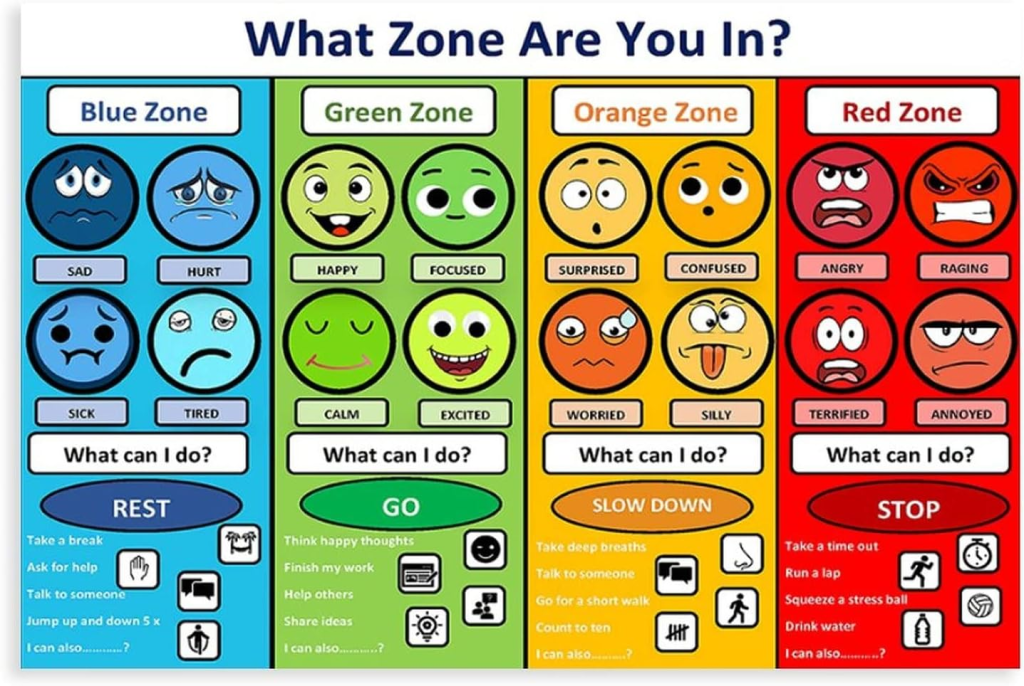
The Zones of Regulation organises emotions into four categories each represented with a different colour.
BLUE: When we are in this zone, we feel sad, tired, or sluggish. It is associated with low energy and a sense of being ‘down’ or feeling ‘blue’.
GREEN: This is the ideal zone where we experience calm and focused emotions. We feel happy, content, and ready to learn.
YELLOW: Here we feel a heightened state of emotions, such as frustration, or extreme excitement. When we are in the yellow zone, we struggle to maintain control but we are not in crisis. It is a zone of high energy.
RED: Here, as you already have guessed, we find feelings like anger, panic, or anxiety. We have difficulty managing our actions and reactions. This is another zone of high energy, but in this case the emotions we are feeling are not so positive.

HOW TO START USING THE ZONES OF REGULATION
The Zones of Regulation, like any other approach that aims the social emotional well-being of children, is better when implemented in the whole school. When this becomes part of children’s routines, then we can say the implementation has started to be successful.
VISUAL TOOLS: The Zones of Regulation is a highly visual approach (hence why it is so good for all type of students). So adding posters, charts, or planning interactive activities are good ways to start introducing them in your school.
VOCABULARY: Introduce and embed the vocabulary associated with each zone. This will empower students to express their feelings accurately. You will soon see a change, from only using ‘happy’ or ‘sad’ to hear young children say things like: “I’m feeling frustrated (Yellow Zone)”.
EMOTIONS CHECK-INS: I like when this is done first thing in the morning, as soon as they arrive. They can move their photo to the area or specific emotion they feel at that time. Teachers will be aware, first thing in the morning, of what their students are feeling that day. Once the morning check-ins are embedded, you can expand this by letting them move their photo any time their emotions change throughout the day.
SELF-REGULATION: Teach children strategies to regulate their emotions. For example, deep breathing exercises or mindfulness activities can help them move from Red to Green.
TOOLKITS
These toolkits are tools and strategies that children can use when they find themselves in a specific emotional state (especially when they are in the red or blue zones). Here are some examples:
BLUE Toolkit
- A favourite soft toy or comfort object.
- A cosy blanket or pillow.
- A notebook/journal for writing or drawing about their feelings
- A selection of activities (e.g., reading a book or listening to calming music)
GREEN Toolkit (for children who fidget or struggle staying focused)
- Fidget toys for staying focused.
- Mindfulness exercises like breathing techniques or guided meditation.
- Positive self-talk statements.
- Sensory objects.
YELLOW Toolkit
- Stress balls or squeeze toys.
- Visual or sand timers.
- Calming activities (e.g., drawing or colouring).
RED Toolkit
- A safe space for cooling down or taking a break.
- A personalised emotions chart (for identifying and labelling feelings).
- Calming strategies (like counting to ten or going for a walk).
- Trusted adults or friends to talk to.

Leah M. Kuypers’ Zones of Regulation are a great way to teach emotional intelligence in primary (and secondary) schools. Identifying and talking about our emotions can support our understanding about them. Also, the emotional toolkits help children express, manage and regulate their emotions effectively.
Bibliography:
Kuypers, L. M. (2011). The Zones of Regulation: A Curriculum Designed to Foster Self-Regulation and Emotional Control. Think Social Publishing, Inc.
Winner, M. G., & Crooke, P. (2009). You Are a Social Detective!: Explaining Social Thinking to Kids. Think Social Publishing, Inc.
Bailey, R. (2014). Emotion Regulation: A Matter of Time. The Guilford Press.
Ross, S. W., & Gray, C. (2006). The New Social Story Book: Illustrated Edition. Future Horizons.
 Mr Sanchez Tutoring
One thought on “The Zones of Regulation: Emotional Wellbeing in Primary Schools”