

The Three Mountains Task, a classic and renowned study that provided insights into children’s perspective-taking abilities, was developed by Swiss psychologist Jean Piaget and his collaborator Bärbel Inhelder in 1956. It has become a significant tool for understanding children’s cognitive development and their ability to perceive the world from multiple viewpoints. In this blog post, I want to examine the purpose, the methodology, the conclusions, and theoretical implications of the Three Mountain Task.

Purpose and Background of the Three Mountains Task
The Three Mountains Task was designed to investigate children’s understanding of spatial perspectives and their ability to take another person’s point of view. Piaget and Inhelder were interested in exploring the development of children’s egocentrism, a concept central to Piaget’s theory of cognitive development. Egocentrism refers to the tendency of young children to perceive the world solely from their own perspective, struggling to understand that others may hold different viewpoints.
Methodology and Procedure
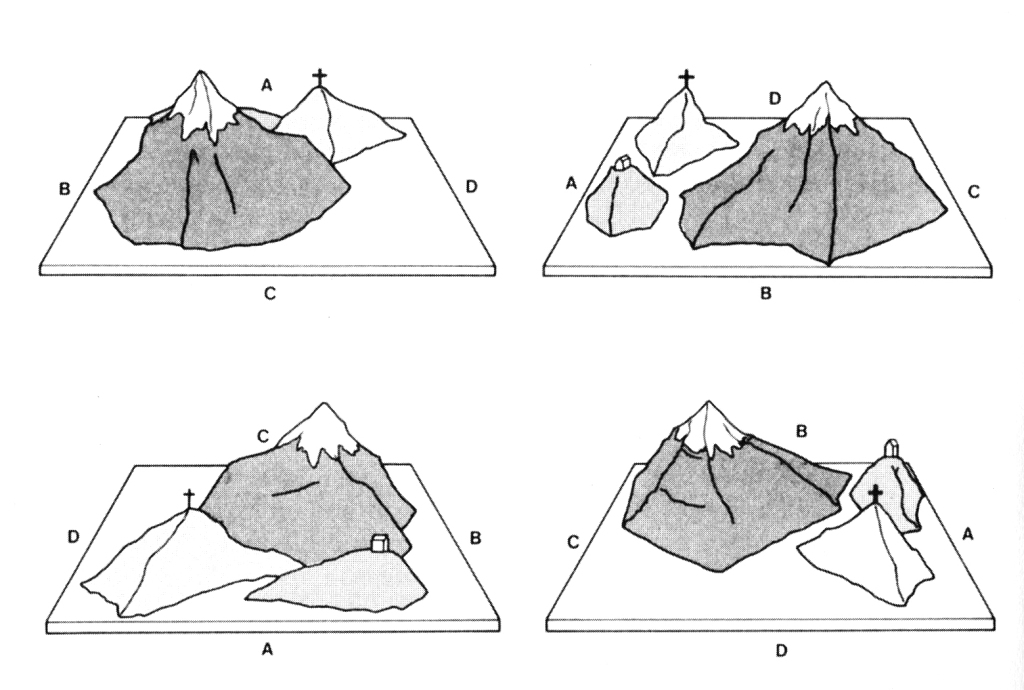
During the experiment, children were presented with a model of three mountains of varying sizes, each with distinct features such as snow-capped peaks, houses, and trees. The children were then seated at a table opposite the model and asked to choose a picture that accurately represented the view from a specific location. The experimenter would sit at a different location and ask the child to select the image that represented what they saw.
The task required the child to mentally put themselves in the position of the experimenter and select the image that corresponded to the experimenter’s viewpoint. The goal was to determine whether children could accurately understand and represent a different perspective, beyond their own egocentric viewpoint.
Findings and Conclusions
Piaget and Inhelder observed distinct developmental trends in children’s performance on the Three Mountains Task. They found that children between the ages of 4 and 7 tended to choose images that reflected their own perspective rather than the experimenter’s viewpoint. This suggested a strong egocentric bias, indicating that young children struggled to differentiate their own perspective from that of others.
However, as children grew older, around 7 or 8 years of age, they demonstrated an emerging ability to take another person’s perspective into account. They became more adept at selecting images that accurately represented the viewpoint of the experimenter. This shift marked the transition from egocentric thinking towards a more sophisticated understanding of multiple perspectives.
Implications and Theoretical Framework
The Three Mountains Task aligns with several prominent learning and child development theories, providing valuable insights into cognitive development:
Piaget’s Theory of Cognitive Development: The Three Mountain Task supports Piaget’s theory, particularly his stage of concrete operational thinking. According to Piaget, children in this stage (7-11 years) gradually acquire the ability to decentre their thinking and understand multiple perspectives.
Vygotsky’s Sociocultural Theory: The Three Mountains Task highlights the role of social interaction and cultural influences in children’s cognitive development. Vygotsky emphasised the importance of social interactions in scaffolding children’s thinking, promoting the development of perspective-taking abilities.
Theory of Mind: The Three Mountains Task is closely linked to the development of Theory of Mind, the understanding that others have beliefs, desires, and perspectives distinct from one’s own. The experiment explains children’s growing ability to attribute mental states to others and recognise that perspectives can differ.
The Three Mountains Task in the Classroom
The Three Mountain Task model continues to be influential in educational settings today, particularly in the field of cognitive development and perspective-taking. Educators often use the principles and understanding from this experiment to inform their teaching practices and support students’ cognitive growth. Here are some ways in which the Three Mountain Task model is applied in classrooms:

Perspective-Taking Activities: Educators design activities and tasks that encourage students to consider different viewpoints and perspectives. These activities can involve exploring literature, engaging in discussions, or solving problems from multiple perspectives. Perspective-taking exercises help students develop empathy, critical thinking skills, and a broader understanding of diverse viewpoints.
Promoting Empathy and Understanding: The model is used to develop empathy and understanding among children. Educators create opportunities for students to step into the shoes of others and see situations from different angles. This can be achieved through role-playing, simulations, or real-life scenarios. Students can gain a deeper appreciation for the complexities of human experiences and enhance their interpersonal skills.

Developing Critical Thinking Skills: Piaget’s model serves as a foundation for developing critical thinking skills in students. Educators encourage students to question assumptions, analyse information from multiple sources, and evaluate different viewpoints. These tasks develop student’s ability to think critically and help them make well-rounded judgments based on evidence and reasoning.
Enhancing Problem-Solving Abilities: The Three Mountain Task model can be applied to problem-solving situations. Children are challenged to approach problems from various angles, considering different viewpoints and potential solutions. This approach helps them develop flexible thinking, creativity, and the ability to generate alternative strategies.
Cultivating Collaborative Skills: This model supports the development of collaborative skills in students. Educators structure group activities where children must work together to understand and respect diverse viewpoints. This promotes effective communication, teamwork, and cooperation among pupils, preparing them for future collaborative endeavours.
Self-Reflection and Metacognition: Educators encourage students to reflect on their own thinking processes and become aware of their own perspectives and biases. By engaging in metacognitive practices, such as analysing their thinking, considering alternative viewpoints, and reflecting on the impact of their own perspectives, children develop self-awareness and become more open-minded learners.
Conclusion
The Three Mountain Task, pioneered by Piaget and Inhelder, has significantly contributed to our understanding of children’s cognitive development, particularly their ability to take another person’s perspective. The experiment revealed that as children grow older, they become better at differentiating their own viewpoint from others, gradually overcoming their egocentric tendencies. The Three Mountain Task aligns with influential theories of learning and child development, shedding light on the complex processes involved in perspective-taking and the development of cognitive abilities.
Three Mountain Task serves as a valuable tool for educators and researchers in designing educational interventions and understanding the underlying mechanisms of cognitive development. It emphasises the importance of fostering perspective-taking abilities and promoting children’s awareness of diverse viewpoints, laying the foundation for empathy, understanding, and effective social interactions.
References:
Piaget, J., & Inhelder, B. (1956). The child’s conception of space. Routledge.
Flavell, J. H., Miller, P. H., & Miller, S. A. (2002). Cognitive development (4th ed.). Prentice-Hall.
More interesting research in these blog posts:

 Mr Sanchez Tutoring
3 thoughts on “Children’s Egocentrism: The Three Mountains Task”